
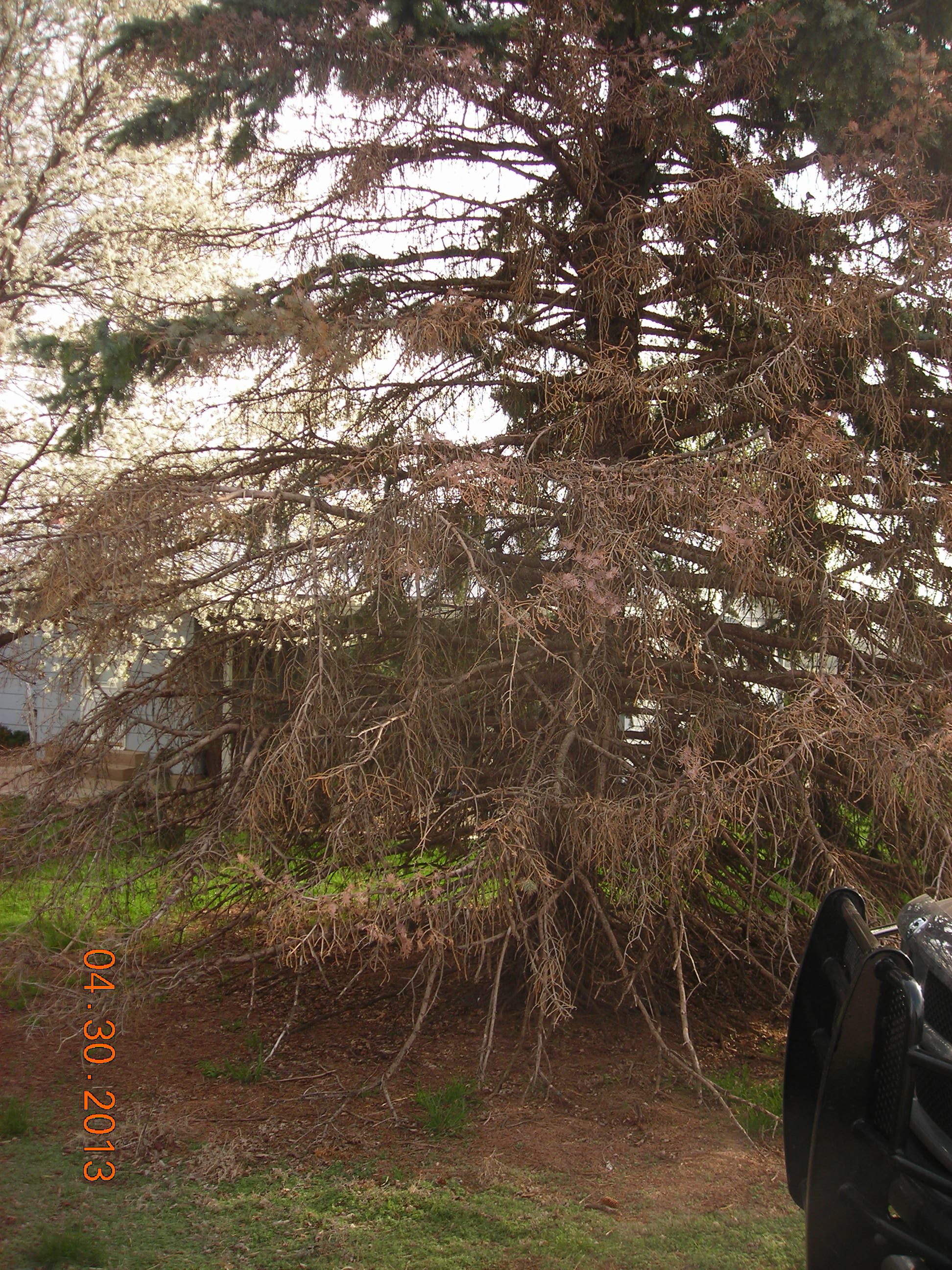
A client’s spruce tree
The most common horticulture question this season has been “What’s wrong with my evergreen tree?” While this may sound like an easy question to answer, the solution really depends on the symptoms, the trees affected, and the plants’ history.
Many trees have been showing symptoms this year that are actually the result of last year. A few of the most common trees that have been showing symptoms are arborvitae, cedar, and spruce. While we think of these trees as being tough-as-nails, every plant has its threshold. These trees are tough until the going gets rough and the moisture gets short. Browning foliage or completely missing needles have plagued these species. The most common cause of these symptoms we have been seeing in these trees is due to the drought and lack of moisture. Trees that didn’t receive supplemental water during the drought last summer or throughout the winter are just now showing symptoms. Deciduous trees were also affected by last years’ drought. Symptoms can include slow bud break, stunted growth, or even plant death.
How severely the plant was affected can make a difference in how you tackle the recovery. If you have trees that are completely brown or have no needles or leaves, the sad news is that they probably won’t recover and replacement might be your best option. If you have trees that have brown spots or branches in the canopy or are just slow to leaf out, there could still be hope. Make sure that trees have at least an inch of supplemental water a week in the absence of precipitation or irrigation. Do not fertilize stressed trees. It could cause more harm than good.
Pine problems are also plaguing many homeowners. Where the brown is occurring in the tree can make a difference in what is affecting them and how to treat it. Trees with brown tips on this years’ new growth, could be caused by a fungus. Last years’ new growth that is half brown and half green could have also been caused by a fungus. Sphaeropsis tip blight and dothistroma needle blight are common in older, well-established trees. The fungi that cause these diseases overwinter in dropped needles or pinecones. The best time to spray for either of these fungal infections is earlier in the season around April or May, depending on the fungus. Right now if you are noticing brown tips, they can be pruned out, but it is too late for fungicide applications for this year. The trees with needle blight often are still able to photosynthesize with the remaining needles, so curative treatments are rarely recommended.
Another pine problem in our area is pine wilt. The symptoms start as the entire tree or a major branch turns an off grayish green color. As the nematodes progress and multiply the tree turns tan and then eventually brown. The dead brown needles will remain on the tree for a year or more. The wood from the tree will also be very light in weight and have almost no sap or sticky resin in the wood.
Prevention is the best method when it comes to pine wilt. Insecticidal treatments could help to protect high value, susceptible trees. Trees need to get the treatment before they show symptoms of being infested with the nematodes. The cost of the treatment depends on the size of the tree, an average cost is around $200-$300 per tree (approx. 10 inch in diameter). The products must be injected into the tree at least every 2- 3 years. The treatments are between 70-90% effective in preventing pine wilt. Once a tree develops pine wilt, there isn’t a curative treatment. The diseased tree needs to be destroyed to prevent the pine sawyer beetle from leaving the infected tree and spreading the nematodes to nearby healthy trees. If a tree dies May 1 through October 1, it needs to be removed and destroyed immediately. The trees need to be burned, buried, or chipped as soon as possible to prevent the beetles from emerging out of the wood. The wood should not be saved for firewood, but the wood chips can be used as mulch.
Proper identification of the issue is key to knowing the outlook of the situation and the possible treatments.
Can’t get enough horticulture information? Listen on Fridays at 8:15 a.m. on KRGI 1430 am to hear ‘Everything Outdoors.’ It is a live call-in radio show in which Hall County Extension Educator Elizabeth Killinger gets you the answers to your horticulture questions.
For more information contact Elizabeth Killinger at elizabeth.killinger@unl.edu, 308-385-5088, on Facebook, Twitter, her blog at https://huskerhort.wordpress.com/, or visit the University of Nebraska-Lincoln Extension website: hall.unl.edu.

 Husker Hort