Husker Hort

A Nebraska View of Horticulture


Leave a comment

Don’t Forget the Fruit

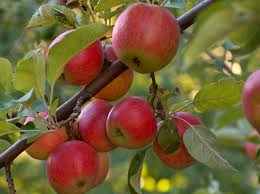
Apple tree.  Photo courtesy ext100.wsu.edu

Apple tree. Photo courtesy ext100.wsu.edu

You know the saying; the apple doesn’t fall far from the tree. Even though apple and other fall fruit harvest is nearing its end, that doesn’t mean that the work is over. Fall sanitation is a key part of fruit management. A little extra work now could ensure a successful growing season next year.

Make sure your fruit trees are ready for the winter to come. Start by making sure that your tree goes into winter with an adequate amount of moisture. The recommendation for trees is to have about 1” of supplemental water per week. This is about enough water to get the top 8” of the soil moist. Fruit trees do not require much fertilization, especially in the fall. As long as the fruit tree is planted in a healthy soil, it will not require fertilization. In the fall we want trees to go dormant, not produce more growth, which is why we avoid fertilizing trees in the fall.

Fruit trees can benefit from good fall sanitation. Healthy fallen fruits or leaves can be collected and placed in the compost pile. Removal of rotting dropped fruit as well as diseased fruit and leaves will help decrease the potential for pathogens to infect next year’s crop. Fruit mummies, dried fruits that remained on the branch, and diseased fruits and leaves should be picked up and thrown away, not put into the compost pile or worked into the soil. Branches that were infected with fire blight and other bacterial or fungal cankers should be removed and disposed of as well.

Protect your fruit trees now for pesky critters. Mow the grass under the tree and as close to the trunk as you can get without causing damage. This will remove good overwintering sites for rodents. Also, be on the lookout for rodent paths or holes where they burrow and use the desired form of control. Before the ground freezes, consider protecting the tree as well. A well-constructed rabbit fence will help to protect smaller trees from becoming a bunny’s next meal. Be sure that the fence is not only 15-18” tall, just in case we get snow, but it also should be buried in the ground 6” to keep the rascals from trying to dig under.

Strawberries could also benefit from a little care before winter. Thinning plants, providing adequate moisture throughout the fall, and mulching in late fall are all important fall care practices. Thin strawberry plants in mid-October and aim for a spacing of five to seven plants per square foot to help allow optimum fruit production the following year. Remove small and weak plants as well as any new runners or daughter plants that have not rooted down yet.

Mulching strawberry plants is another good practice to use. Winter mulch will help prevent or reduce winter damage to the crowns and flower buds of the plants. Wait to mulch strawberries until late November or early December, after the soil has frozen at a depth of ½ an inch or the airtime temperatures have dropped into the 20’s. Mulch applied too early in the fall can delay hardening off, which can lead to the plants being more susceptible to winter injury and possibly crown rot. Mulches that work well for strawberries can include wood chips, pine straw, newspapers, coarse sawdust, clean straw or hay, or any loose mulch that will not compact heavily. Leave the mulch on the plants until the new growth begins, usually in mid-April.

There are a few steps you can take to decrease the spread of pathogens. Machinery and tools should be disinfected on a regular basis and when they come into contact with infected plant material. Steam, hot water under pressure, or a 10% bleach solution can be used to disinfect. Before and after pruning out diseased branches, disinfect pruners and loppers to keep from spreading diseases.

For more information contact Elizabeth Killinger at elizabeth.killinger@unl.edu, 308-385-5088, on Facebook, Twitter, her blog at https://huskerhort.wordpress.com/, or visit the University of Nebraska-Lincoln Extension website: hall.unl.edu.

Leave a comment

Yellow Needles in Pine

IMG_0600

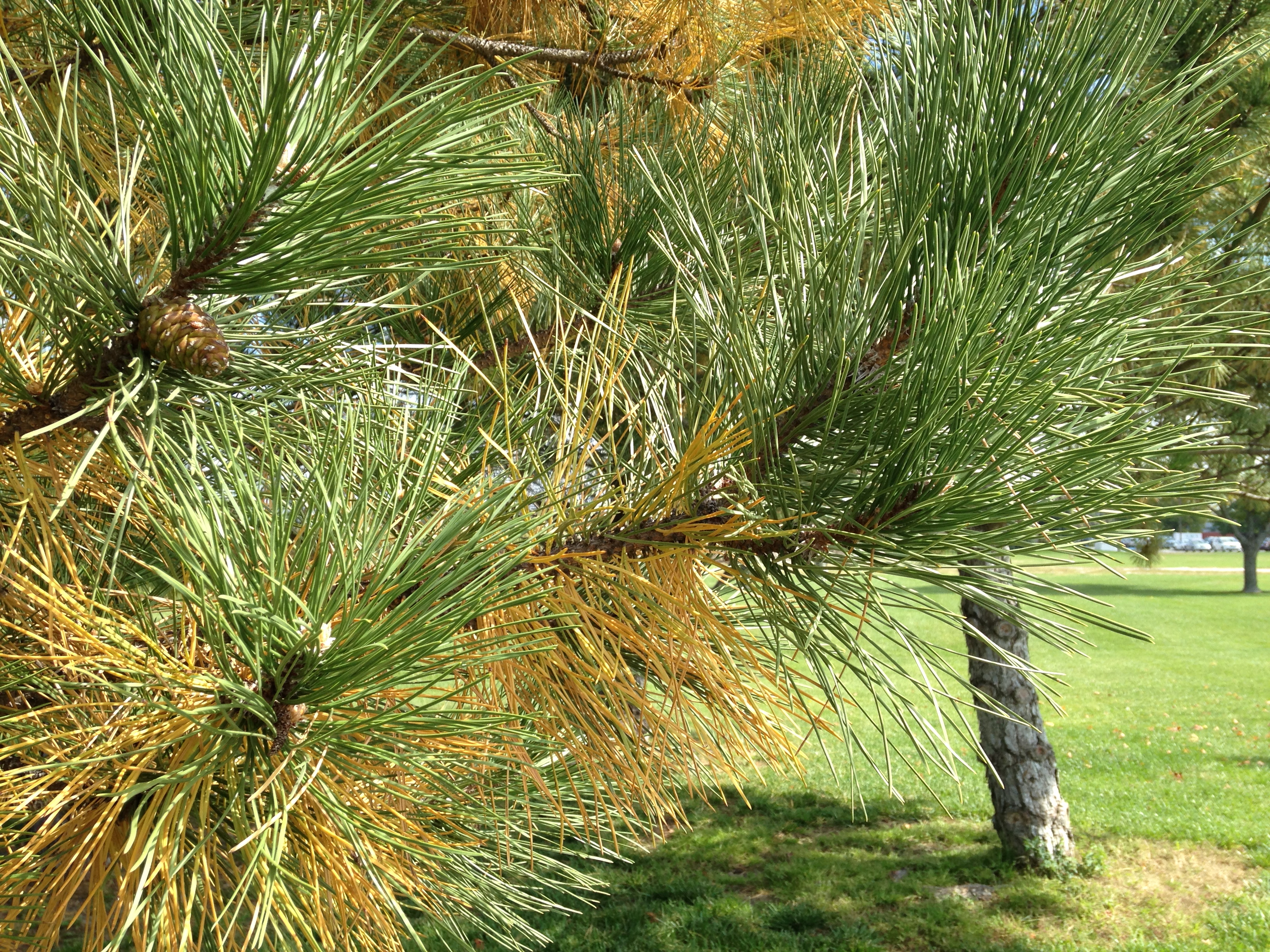
Yellow inner needles

Cooler nights and falling leaves signal that fall is here. Pines in the area are starting to change colors too. Knowing the cause of the discolored needles will help to know if it is nature taking its course or if it is a disease infecting your trees.

Across the area, yellow inner needles in pine and spruce have just started to appear. Evergreen needles change color in the fall too, just like deciduous trees. It is a normal occurrence called natural needle drop. The older interior needles of pine and spruce are turning yellow and drop from the tree. The older needles that are lost are usually located closer to the inside of the tree or trunk. Factors that increase the stress on an evergreen can intensify the autumn needle drop. These stress factors can include drought, herbicide injury, root damage, or insect or disease damage.

White pine with natural needle drop

White pine with natural needle drop

Like many living things, evergreen needles also have a lifespan. Pine trees hold their needles for 2-3 or more years. Spruce trees hold their needles longer than pines, usually around 5-7 years. After the needles have lived their lifespan, they fall from the tree. Some trees, like the white pine, make it easy to see the needle drop.

The location of the discolored needles can determine if it is natural needle drop or if something else has infected the tree. If the tip of the branch was the only part affected this spring, fungus could be to blame. Cool, wet springs are ideal conditions for fungus, this spring was no exception. The Sphaeropsis tip blight fungus will infect the new growth as it emerges causing it to turn brown and hang on. If fungicides are applied, the best time to spray preventative treatments for Sphaeropsis tip blight fungus is April.

Sphaeropsis tip blight

Sphaeropsis tip blight

One of the most common pine diseases is also caused by a fungus and can also cause brown needles. Dothistroma needle blight causes reddish lesions found on individual needles. It causes the needle to appear to be half green and half brown on last years’ growth and mainly affects the lower half of the tree. Preventative fungicide applications can be made in mid-May and again in mid to late-June.

Pine wilt can also cause needles to change color. If the entire branch, or tree, turns brown and the needles hang on, it could be pine wilt. The cause of pine wilt is smaller than we can see with the naked eye. The pinewood nematode is a very small worm-like organism that attacks the tissues that move water and nutrients throughout the tree. The nematode doesn’t travel very far by itself, so it uses a ‘friend’ to help it move around. Nematodes hitch a ride on pine sawyer beetles and fall off when they reach a new tree to infest. The first symptom is the tree or a major branch will have a grayish green tint to it. As the nematodes progress and multiply the tree turns tan and then eventually brown. One important thing to remember is that the dead brown needles will remain on the tree for a year or more

Pine Wilt in Scotch Pine

Pine Wilt in Scotch Pine

One way to prevent needles from changing color next spring is through irrigating now. Moisture helps to promote root growth and reduces winter desiccation injury. Supplemental fall irrigation should be continued, when there isn’t precipitation, until close to soil freeze. When air temperatures in winter are above 40 degrees Fahrenheit apply water early enough in the day so it can soak into the ground before temperatures drop below freezing. This will help to avoid the water from freezing on the surface at night when the temperatures drop down. Apply enough water to moisten the soil eight inches deep under the drip line of the tree. Be sure to check the soil moisture before irrigating to avoid irrigating a saturated soil.

Proper identification of the culprit behind the color changing needles can help you determine if this is nature taking its course or if you have some action to take in the future.

For more information contact Elizabeth Killinger at elizabeth.killinger@unl.edu, 308-385-5088, on Facebook, Twitter, her blog at https://huskerhort.wordpress.com/, or visit the University of Nebraska-Lincoln Extension website: hall.unl.edu.


2 Comments

Is that a Webworm or a Bagworm?

Webworms, bagworms, are they the same thing? If not, why does it make a difference whether you have a bagworm or webworms? It can make a big difference which insect you have to control and the damage that they cause. Correct identification is key to know how to control these pests.

Fall webworms or tent caterpillars are an occasional pest. They are sometimes called ‘bagworms,’ but using the correct common name will help clear up confusion. They appear as white webbed nests on the ends of branches in cottonwood, crabapple, walnut, and other trees. The caterpillars hide in the webbed nest during the day and feed on the trees at night. The caterpillars cause little harm to otherwise healthy trees. Tree health is not usually affected until more than 50 percent of the foliage is eaten. If there are enough nests, about one on every branch, the tree could be completely eaten. If you can safely reach the nest, use a broom to break up the bag of webworms. Follow up by spraying with a strong stream of water or an insecticide like permethrin (Eight) or Spinosad (Conserve). The nests can also be pruned out when possible. Trees that have heavy infestations this year won’t necessarily have a similar outbreak next year.

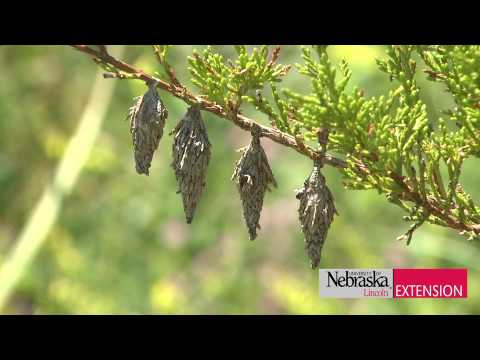
Bagworms on a juniper.


Bagworms are a whole different story from webworms. Bagworms will feed on a wide variety of trees and shrubs, but they mainly prefer evergreens, especially junipers, cedars, and spruce. The reason that they are called bagworms is because they spin their own individual cases or bags around them for protection. As the bagworm grows, so does the bag that contains them. They will add leaf fragments to the outside of the bag for camouflage. The bags look like baseball bat-shaped ornaments hanging from the trees. There is one way to know if your cedar tree has bagworms. If you see little cone shaped things on your cedar tree, more than likely you have bagworms, because cedar trees don’t produce cones.

The earliest sign of bagworm injury on junipers is brown stressed needles at the tips of the branches. If the infestation is severe enough, the tree they are feeding on will have a brown tint to it. Heavy infestations of older bagworms are capable of completely defoliating a tree or shrub. This can cause stress to the plant or even kill it if damage is great enough. This is especially true if they have infested an evergreen which is unable to re-grow new foliage until next year. If you have bagworms on any deciduous plant, ones that lose their leaves every year, they are able to re-grow foliage if needed. Just be sure to pick up the leaves this fall and dispose of them.

There are several options for controlling bagworms. Insecticidal sprays require thorough coverage to penetrate the canopy and contact the feeding bagworms. It is generally preferable to use ground equipment with higher spray volumes and pressures. Aerial applications may fail to provide thorough enough coverage resulting in less than satisfactory bagworm control. The spray has to completely cover the plant, almost to the point the product is dripping off of it. If the bagworms have made their home on a windbreak, the applicator has to be sure to have enough pressure to get product between the two rows of the windbreak. If this area is missed the bagworms that were hiding out there will move and re-infest the rest of the plant. Hand removal is another option for controlling bagworms. After removing the bags, place them in a bucket of soapy water.

There are several options available for insecticidal control of bagworms. Some of the reduced-risk options include Bacillus thuringiensis (Bt), spinosad, or azadirachtin (neem oil) are effective on young larvae and may be needed to be applied repeatedly. Additional insecticidal options include permethrin (Eight), bifenthrin (Talstar), cyfluthrin (Tempo), chlorantraniliprole, carbaryl (Sevin), dimethoate, esfenvalerate, fluvalinate (Mavrik), lambda-cyhalothrin, acephate (Isotox IV), and tebufenozide (Confirm). Depending on the product and size of the insect, secondary applications may be needed.

Be on the lookout now for webworms and bagworms and control them before they make a meal out of your plants.

For more information contact Elizabeth Killinger at elizabeth.killinger@unl.edu, 308-385-5088, on Facebook, Twitter, her blog at https://huskerhort.wordpress.com/, or visit the University of Nebraska-Lincoln Extension website: hall.unl.edu.


Leave a comment

Live Christmas Trees are for the Birds

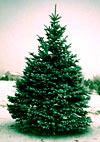
bluesprucecjlgLive Christmas trees add an unmistakable ambiance to the holidays.  Now that the holidays are over, the time has come to let your tree perform a different task.  Get good use out of your live Christmas tree for a while longer.  Feeding birds has become a very popular pastime that can be done year round.  There are three things to remember for bird feeding success: location, providing the correct feed and feeder for the bird you want to attract, and maintaining a constant availability.

There are a few steps you should take with your Christmas tree before you stick it outdoors for the birds.  Remove all decorations, lights, and try to remove as much of the tinsel, if not all, if possible.  The best location for the tree once outdoors is on the south or east side of the house.  This will provide shelter from the harsh north and west winter winds.  Be sure the tree is secure in its new location by setting the stump in the ground or bucket of damp sand and by attaching the top with twine to nearby buildings or trees.

Christmas trees can create a wonderful backyard habitat.  The tree can provide shelter for the birds by protecting them from the wind and predators.  It can also act as a feed station. For a fun winter project, make your own bird feeders.  Popcorn, cranberry, and raisin strings are not only festive, but they also help to feed the birds.  Popcorn will attract cardinals and finches, while cranberries and raisins attract cedar waxwings and any overwintering robins.  Apples, oranges, leftover bread, and pine cones covered with peanut butter and rolled in birdseed also make great feeders.

The saying that works with real estate also works for bird feeders– location, location, location.  Most birds prefer to feed when they are protected from the strong winds and where they can have areas with protective cover and perching sites.  Trees and shrubs nearby offer excellent perching sites while evergreens provide great cover for birds to hide.

The types of feeders and the feed you offer will determine the types of birds that you will have visiting.  Birds tend to be pretty picky with the type of feed and feeder that they prefer.  Goldfinches are easy to attract if you use niger thistle seed in a clear tube-type feeder.  Woodpeckers and nuthatches are fond of suet.  Suet is a combination of animal fat, seeds, and other ingredients that attracts insect eating birds.  It offers a quick source of energy for birds.  Suet feeders are usually a plastic-coated wire cage.  There are a wide variety of feeder types available at most home and garden centers or you can make your own.  Pick a feeder that you enjoy looking at, is easy to fill, fits the type of bird you want to attract, and fits within your price range.

In winter birds rely on you and what you have to offer.  Once you decide to start feeding the birds, it should be done consistently.  Feeding the birds in the winter makes them reliant on you for part of their diet.  Forgetting to feed the birds during a severe cold period or storm could mean that they could starve to death before they find another food source.

When your live Christmas tree has fed all the neighborhood birds be sure to take it to your local recycling areas where it can be made into habitat or useful mulch.  Grand Island had three locations; ACE Hardware at the west end of the parking lot, the north side Skagway south parking lot, and the Conestoga Mall just north of Red Lobster.  Trees can be dropped off at these locations until January 5th and will be chipped into mulch.

Upcoming Programs:

Nebraska Extension Master Gardener Program- Two training sessions will be held at the UNL Extension in Hall County meeting rooms in Grand Island NE.  Session 1: Tuesday evenings, February 11 through March 25, 6:00 to 9:00 PM.  Session 2: March 17, 19, 21, 24, 26, and 28 from 9:00 a.m. to 4:00 p.m.  Please contact Elizabeth Killinger, 308-385-5088, with any questions about the program.  Registrations are due prior to January 7 with the session you are interested in attending.  More information, updated schedules, and an application can be found at http://hall.unl.edu

For more information contact Elizabeth Killinger at elizabeth.killinger@unl.edu, 308-385-5088, on Facebook, Twitter, her blog at https://huskerhort.wordpress.com/, or visit the University of Nebraska-Lincoln Extension website: hall.unl.edu.


1 Comment

Celebrate ReTree Nebraska Week

Photo of Youth Planting a Tree in Lincoln, NE. (courtesy ReTree NE)

Photo of Youth Planting a Tree in Lincoln, NE. (courtesy ReTree NE)

Every good Nebraskan knows we are the home of Arbor Day.  Did you know we also have another opportunity to celebrate trees?  ReTree Nebraska week is dedicated to trees.  Find out why we should re-tree Nebraska and how you can take part in this week long celebration from September 22nd – 28th.

ReTree Nebraska is a cooperative initiative of the Nebraska Forest Service, Nebraska Statewide Arboretum, University of Nebraska Rural Initiative, University of Nebraska–Lincoln Department of Agronomy and Horticulture, and Nebraska Community Forestry Council.  It is a 10-year cooperative initiative which will raise public awareness of the value of trees, reverse the decline of Nebraska’s community tree resources, and improve the diversity and sustainability of trees in communities across the state that will last for generations to come.

Severe weather, drought, poor planting practices or species selection, insects, disease and an aging tree population all have contributed to the decline in the number of community trees across the state. Planting new trees is an essential part of maintaining Nebraska’s community forest, and fall planting offers important benefits.

Just because we are a ‘Prairie State’ doesn’t mean that we don’t have or need trees.  Across Nebraska, there are about 470,000 acres of community forests. These trees were planted by previous generations who understood the long-term benefits they would provide, such as cleaner air, healthier soil and wildlife habitats. Planting a tree provides much-needed shade during hot Nebraska summers, which helps reduce energy costs for homeowners, schools and businesses.  Every dollar invested in the community forest returns an average of $2.70 in net annual benefits. Nearly $9.7 billion in environmental, social and economic benefits are provided by 13.3 million trees in Nebraska communities, but that’s half the number of trees that were present 30 years ago.

Fall is an optimal time for tree planting.  “Fall is a great time to plant trees in Nebraska because there are fewer demands on the roots, allowing trees to establish their root systems and get a jump start on spring growth,” according to Jessica Kelling, ReTree Nebraska coordinator.

When selecting a tree species, Kelling recommends considering a couple of key factors. Plant a different species than what is already growing in adjacent areas. “Enjoy the two weeks of fall color your neighbor’s red maple provides, but select a tree for your yard that provides some variety in leaf texture, form and fall color to create a diverse landscape year round.”  Kelling also urges homeowners to take a tree’s mature height and width into consideration when selecting a species for planting. “Go to the planting site and look up, down and around for conflicts with buildings, utility lines and even other trees.”

If you are looking for a good tree to plant this ReTree Week, ReTree Nebraska has “Thirteen for 2013,” a list of underutilized tree species.  The trees are broken down by size and type and include:

Evergreen- Concolor fir—Abies concolor, Black Hills spruce– Picea glauca var densata,

Small to Medium Deciduous Trees- Shantung maple—Acer truncatum, Miyabe maple—Acer miyabei,  Gamble Oak- Quercus gambelii, Japanese or Pekin Tree lilac-Syringa reticulate (‘Ivory Silk’) or Syringa reticulate ssp. pekinensis (Copper Curls®)

Large Deciduous Trees- Kentucky coffeetree—Gymnocladus dioicus, Northern catalpa—Catalpa speciosa, Baldcypress—Taxodium distichum, Bur oak—Quercus macrocarpa, Chinkapin oak—Quercus muehlenbergii, English Oak—Quercus robur, Elm hybrids—Ulmus x (‘Accolade’, ‘Cathedral’, ‘Frontier’, ‘New Horizon’, ‘Pioneer’, ‘Triumph’, ‘Vanguard’), Black or Bigtooth Maple- Acer nigrum or Acer grandidentatum

We can work together to celebrate this week as well as support a grassroots, or rather tree roots, Nebraska initiative. To learn more about ReTree Nebraska, report a tree planting, or find out more about tree selection, planting and care, visit www.retreenebraska.unl.edu or email retreenebraska@unl.edu.

For more information contact Elizabeth Killinger at elizabeth.killinger@unl.edu, 308-385-5088, on Facebook, Twitter, her blog at https://huskerhort.wordpress.com/, or visit the University of Nebraska-Lincoln Extension website: hall.unl.edu.

Leave a comment

What’s Wrong with My Tree?

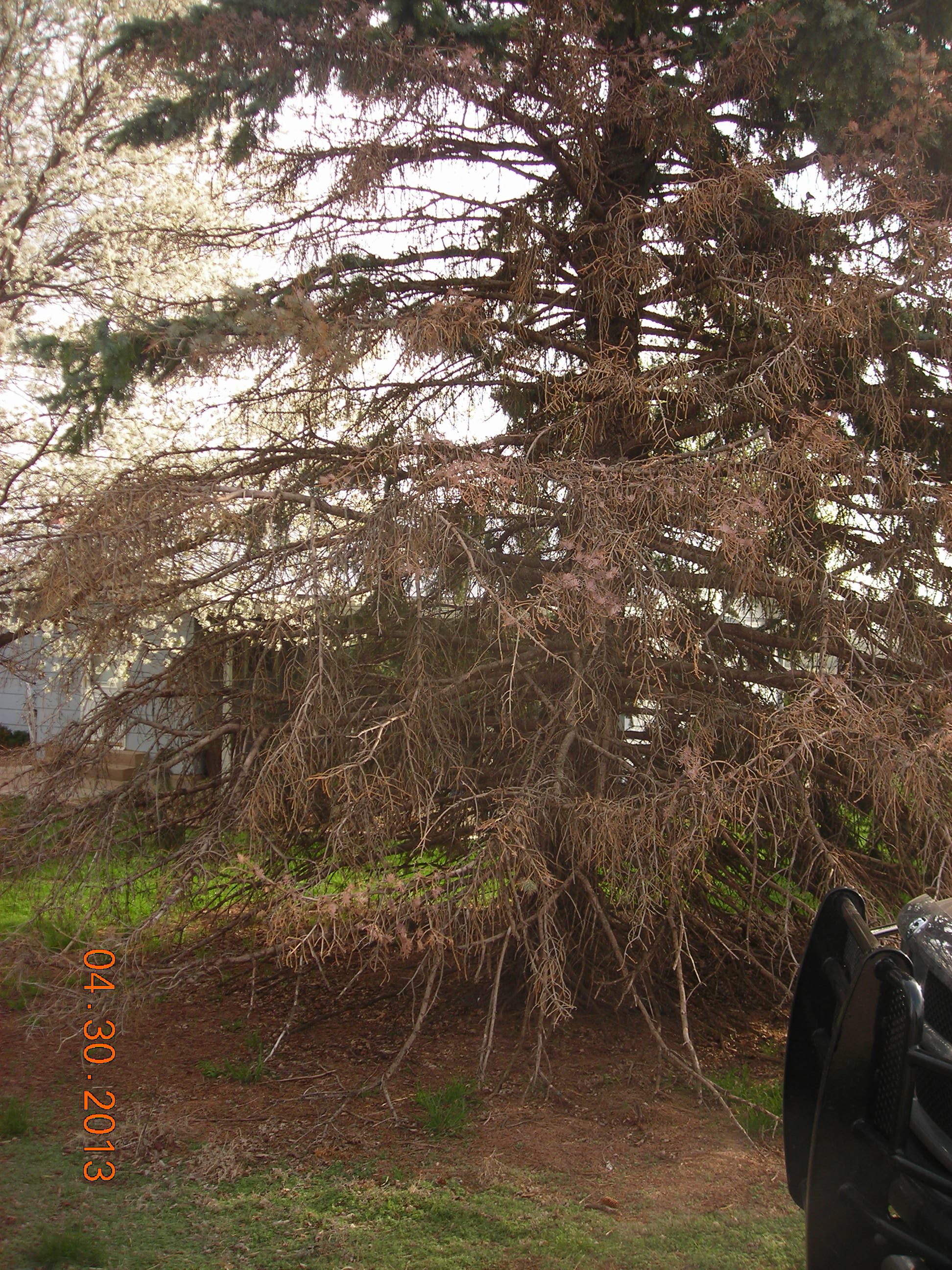
A client's spruce tree

A client’s spruce tree

The most common horticulture question this season has been “What’s wrong with my evergreen tree?”  While this may sound like an easy question to answer, the solution really depends on the symptoms, the trees affected, and the plants’ history.

Many trees have been showing symptoms this year that are actually the result of last year.  A few of the most common trees that have been showing symptoms are arborvitae, cedar, and spruce.  While we think of these trees as being tough-as-nails, every plant has its threshold.  These trees are tough until the going gets rough and the moisture gets short.  Browning foliage or completely missing needles have plagued these species.  The most common cause of these symptoms we have been seeing in these trees is due to the drought and lack of moisture.  Trees that didn’t receive supplemental water during the drought last summer or throughout the winter are just now showing symptoms.  Deciduous trees were also affected by last years’ drought.  Symptoms can include slow bud break, stunted growth, or even plant death.

How severely the plant was affected can make a difference in how you tackle the recovery.  If you have trees that are completely brown or have no needles or leaves, the sad news is that they probably won’t recover and replacement might be your best option.  If you have trees that have brown spots or branches in the canopy or are just slow to leaf out, there could still be hope.  Make sure that trees have at least an inch of supplemental water a week in the absence of precipitation or irrigation.  Do not fertilize stressed trees.  It could cause more harm than good.

Pine problems are also plaguing many homeowners.  Where the brown is occurring in the tree can make a difference in what is affecting them and how to treat it.  Trees with brown tips on this years’ new growth, could be caused by a fungus.  Last years’ new growth that is half brown and half green could have also been caused by a fungus.  Sphaeropsis tip blight and dothistroma needle blight are common in older, well-established trees.  The fungi that cause these diseases overwinter in dropped needles or pinecones.  The best time to spray for either of these fungal infections is earlier in the season around April or May, depending on the fungus.  Right now if you are noticing brown tips, they can be pruned out, but it is too late for fungicide applications for this year.  The trees with needle blight often are still able to photosynthesize with the remaining needles, so curative treatments are rarely recommended.

Another pine problem in our area is pine wilt.  The symptoms start as the entire tree or a major branch turns an off grayish green color.  As the nematodes progress and multiply the tree turns tan and then eventually brown.  The dead brown needles will remain on the tree for a year or more.  The wood from the tree will also be very light in weight and have almost no sap or sticky resin in the wood.

Prevention is the best method when it comes to pine wilt.  Insecticidal treatments could help to protect high value, susceptible trees.  Trees need to get the treatment before they show symptoms of being infested with the nematodes.  The cost of the treatment depends on the size of the tree, an average cost is around $200-$300 per tree (approx. 10 inch in diameter).  The products must be injected into the tree at least every 2- 3 years.  The treatments are between 70-90% effective in preventing pine wilt.  Once a tree develops pine wilt, there isn’t a curative treatment.  The diseased tree needs to be destroyed to prevent the pine sawyer beetle from leaving the infected tree and spreading the nematodes to nearby healthy trees.  If a tree dies May 1 through October 1, it needs to be removed and destroyed immediately.  The trees need to be burned, buried, or chipped as soon as possible to prevent the beetles from emerging out of the wood.  The wood should not be saved for firewood, but the wood chips can be used as mulch.

Proper identification of the issue is key to knowing the outlook of the situation and the possible treatments.

Can’t get enough horticulture information?  Listen on Fridays at 8:15 a.m. on KRGI 1430 am to hear ‘Everything Outdoors.’  It is a live call-in radio show in which Hall County Extension Educator Elizabeth Killinger gets you the answers to your horticulture questions.

For more information contact Elizabeth Killinger at elizabeth.killinger@unl.edu, 308-385-5088, on Facebook, Twitter, her blog at https://huskerhort.wordpress.com/, or visit the University of Nebraska-Lincoln Extension website: hall.unl.edu.