Husker Hort

A Nebraska View of Horticulture


Leave a comment

Fall Turf Care

*This post was written BEFORE a majority of the state received snow 😉

Fall is good for more than just raking leaves and cooler nights. Fall is actually one of the better times of the year to improve your turf. Take advantage of these cooler temperatures and prepare your lawn for the coming spring.

The first question to ask yourself this fall is; can you see your turfgrass in the lawn? Heavy layers of leaves can do a few things to your lawn. If they are thick enough, leaves can smother the lawn and also create conditions that can be favorable to snow mold. Raking or mowing the leaves on a regular basis can help to prevent this heavy layer of leaves from forming and matting down on the turf before winter. If the leaves aren’t utilized in the compost pile or worked into the garden soil, they can simply be mowed over. Using the mulching blade on the lawn mower will chop up the leaves into smaller pieces that are able to filter down between the grass blades. This helps keep you from having to haul the leaves away and it also helps to add organic matter back into the soil. By removing or mulching the leaves on the lawn, you can ensure that your high quality winterizer fertilizer will be able to filter down to the soil where it can be used by the turfgrass, rather than sitting up on top of the leaf litter.

Good news. There is still time to control pesky perennial weeds. The ideal season to control perennial weeds like ground ivy, also known as Creeping Charlie, was between September 15th and the first frost, but there is still time. Research out of Purdue shows that herbicides that contain triclopyr, like Turflon, were effective on ground ivy and retained their effectiveness when applied later in the season regardless of the first frost. The study showed that broadleaf applications should be effective when made into the first week or two of November, but control might be not be seen until spring.

It may be time to rethink what you knew about winterizer fertilizer applications. Previously, recommendations were to apply nitrogen during early to mid-September and then make a heavy application of nitrogen fertilization at the end of the growing season (early to mid-November). Research has shown that nitrogen fertilizer uptake is not as efficiently used later into the fall. Fertilizer that isn’t taken up by the plant sits in the soil until the following spring or is leached out of the soil profile during winter. Avoid applying fertilizer too late into the fall. September fertilization is best to maximize recovery from summer stress and prepare for winter. For the last application of the season, apply it no later than the first week of November and aim to apply not more than 0.75 lb. of a fast release nitrogen source.

With a little time and effort now, your lawn can still look green and lush next spring and hopefully with a few less weeds too.

For more information contact Elizabeth Killinger at elizabeth.killinger@unl.edu, 308-385-5088, on Facebook, Twitter, her blog at https://huskerhort.wordpress.com/, or visit the University of Nebraska-Lincoln Extension website: hall.unl.edu.

Leave a comment

Never say never…

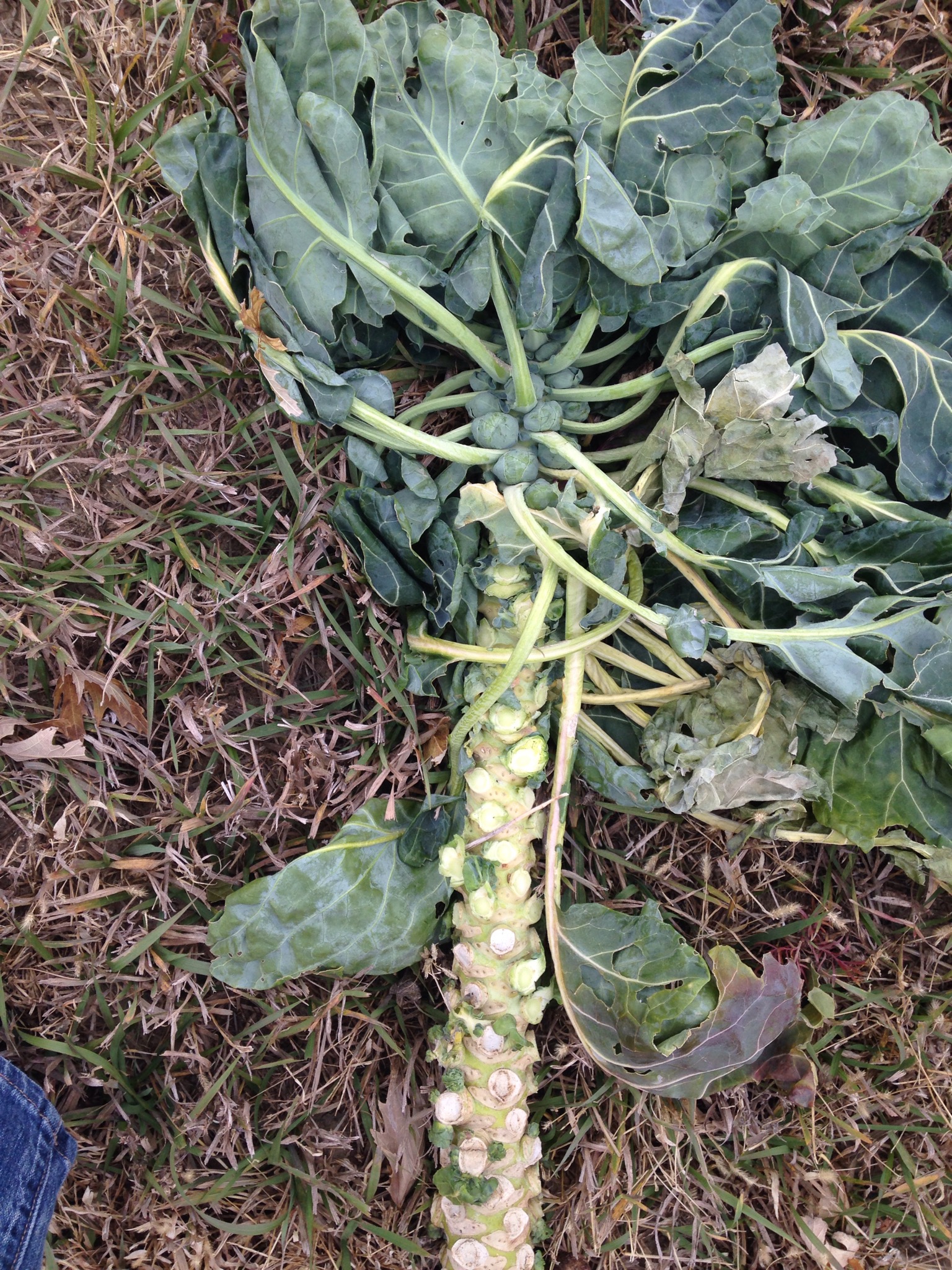
I had never been a fan of Brussels sprouts. The only ones I had growing up were bitter, mushy, frozen balls of nasty (can you tell just how much I didn’t like them). I grew up in a house where you took as many bites of a vegetable for every year old you were, Brussels sprout days were really rough.

Enough about my childhood, fast forward to this spring. While shopping for transplants for our garden, there where the dreaded sprouts in the nursery. I let our 2 year old son help me pick out what veges we would grow in our garden and you guessed it, he picked the Brussels sprouts.

Not wanting to dash his dreams of growing the veges he picked out, we got the sprouts. I feel that it is important for my child to grow the vegetables we eat so he can make the connection between the garden and what is on his plate… SO we got the Brussels sprouts.

In terms of vegetables, they are one of the easiest ones I have grown. The only issue we had were the cabbage worms, which were fairly easy to control.

I was told the key to Brussels sprouts was to wait until after the first frost before picking the tiny cabbages. After our first frost, we picked a few sprouts.

The good news about these vegetables is that they can handle the cool temperature until it drops into the 20’s , extending the harvest.

With the impending polar vortex and drop in temperatures, the time had come to harvest the plants.

I removed the sprouts from the stalks, took off the outer leaves, then placed the sprouts in salted water. This is just in case I wasn’t as good at cabbage worm control as I thought.

I consider our Brussels sprout experiment a success. My son might not love them yet, but I have to say they are not as bad as I previously thought. I am having fun trying the sprouts in different recipes.

So never count any vegetables out, and never say never.

IMG_0872.JPG


2 Comments

Bothersome Boxelder Bugs

Boxelder bugs gathered together on a home's foundation.

Boxelder bugs gathered together on a home’s foundation.

Daylight Savings time is ending and it is time to ‘fall back’ once again. Fall brings about cooler temperatures, changing leaves, and boxelder bugs by the millions. Find out what you can do to help keep these pests from invading your home.

Depending on where you grew up, the boxelder bug can have many names. Some of the more common ones include; maple bug, democrat bug, populist bug, and politician bug. Regardless of what you call them, they are annoying to say the least. The boxelder bug gets one of its common names from its primary host plant, the female boxelder tree. They can also be found on ash, and maple, and occasionally feeding on strawberries, grasses and other plants. The adults are ½ inch long red with black coloration under their wings. This time of the year they begin to cover the south and west sides of homes and try to make entry inside any way possible.

The cycle all begins in the spring. After emerging from overwintering sites, the adult females lay eggs onto the host plants. The bright red nymphs (see the photo), immature bugs, hatch from the eggs in about 2 weeks and begin to feed on plant sap until mid-summer when they mature into adults. The adults lay eggs for a second generation of boxelder bugs. After the second generation matures, the adults seek out warm overwinter sites, to start the cycle over the following spring.

Homeowners become more familiar with these insects in the fall. When looking for overwintering sites, boxelder bugs often find their way into buildings and homes through small cracks and crevices. Once inside the home they are more of a nuisance than anything else. They do not bite, damage food or any items in the home, or reproduce, but they can stain curtains or walls, especially when squished.

Trying to control these insects can feel like a losing battle. While it may be tempting to remove the boxelder trees from the premises, it won’t control all of your problems. The adults are good flyers and can still invade homes from considerable distances from the host plants. The plants are rarely injured seriously enough to justify insecticidal control, but using an insecticide spray on the nymphs can reduce the number that reaches maturity. The most commonly used control method is to use an integrated approach of sealing cracks and crevices and to use a perimeter spray around the exterior foundation and thresholds of the home.

Once they are inside the home, the vacuum cleaner will be the best technique for control. To keep from having to dump or change the vacuum cleaner bag after every use, place a knee high panty hose or trouser sock over the end of the hose before you put on the attachment end. This ‘trap’ collects the insects so they don’t have to go all the way through the vacuum and helps to keep your machine from smelling like boxelder bugs and multi-colored Asian lady beetles every time you turn it on.

Just like the boxelder bugs it’s time to start preparing for winter and get ready to emerge in the spring to start all over again.

For more information contact Elizabeth Killinger at elizabeth.killinger@unl.edu, 308-385-5088, on Facebook, Twitter, her blog at https://huskerhort.wordpress.com/, or visit the University of Nebraska-Lincoln Extension website: hall.unl.edu.


Leave a comment

Farm Bill Education

Brandy VanDeWalle's avatarViews from VanDeWalle

Crop producers are faced with a complex Farm Bill and important decisions to make. My colleague in Hamilton County, Todd Whitney wrote a good article on this so I’ve decided to share it in this week’s column. Landowners and producers should verify that their FSA Farm Numbers are correct for 2014 base acres and 2014 CC (counter-cyclical) program yields. Then, one-time farm program option decisions will need to be determined which will last for the next five years; following sign-ups.FarmBillPic

As a result, Farm Bill informational & meetings will be conducted in every county across Nebraska with each educational session running about 2½ hours. Check with your local Farm Services Agency (FSA) or Nebraska Extension Service (UNL) office for more details. These sessions are not required but may be helpful regarding long-term decisions.

Close training dates are as follows: Nov. 21 – Saline county (Saline Center) – 9 am, Nov…

View original post 514 more words