Husker Hort

A Nebraska View of Horticulture


Leave a comment

Big Red Crops Camp: Youth Discover Crop Science

Awesome opportunity for youth to learn more about crops.

Brandy VanDeWalle's avatarViews from VanDeWalle

Are you interested in science, agriculture, plants, crops, insects, or diseases? If so, join our team of detectives to solve crop-related problems in the Crop Science Investigation (CSI) Big Red Camp! Become a detective while participating in hands-on sessions to learn about and increase your knowledge of crops, science, and agricultural careers. Youth detectives will interact with agronomic professionals across Nebraska to solve experiments in: nutrient management; managing disease, insect and weed problems; water management; crop production, and much more! Do you have what it takes to become a CSI detective?

Youth in Crop Sciences Investigation (CSI) workshops learn about crop production and have the opportunity in investiage what pests might be present in the field. Youth who attend Big Red Camp – Crop Science learn about crop production and have the opportunity in investigate what pests might be present in the field.

There are a variety of careers related to plant sciences such as: Agricultural Communicator; Agronomist; Crop Consultant; Crop Insurance Adjuster; Educator; Co-op Manager; Farmer or Rancher; Farm Credit Banker; Field or…

View original post 125 more words


Leave a comment

BEES…Everything you ever wanted to know (and more)

Bees and Horticulture go hand-in-hand.

lindsaychichester's avatarAgricultural with Dr. Lindsay

TNatalia_photohe day you have been waiting for: BEES…Everything you ever wanted to know (and more)series with my colleague and friend, Natalia Bjorklund, UNL Extension Educator and PhD candidate. Natalia and I had a lot of fun getting together and filming these videos (as I am sure you will be able to tell).

Today I want to introduce Natalia to you and give you a feel for who she is. I love her passion and expertise for what she is doing and look forward to working with her again.

In the days to come I will continue to add videos about various questions such as BEE 101, bee habitat, importance of bees, concerns about bees, bees and GMOs, and more.

It is not too late to submit questions if you have any.

——————————–

Dr. Lindsay can also be found on:

– Website (http://food.unl.edu/ag-and-food)
– Twitter/Instagram (agwithdrlindsay)

View original post 9 more words


Leave a comment

Problems With Pine Wilt?

Tree on the far left was killed by pine wilt.  The others quickly became infested.

Tree on the far left was killed by pine wilt. The others quickly became infested.

There is a problem affecting pine trees in Nebraska, pine wilt. Pine wilt is caused by a tiny organism that can produce big problems. With a little education you can be well informed on this problem and know what to do if it happens. Continue reading


Leave a comment

How To Break Wind…With A Windbreak

Cedar Tree Windbreak

Cedar Tree Windbreak

Snow is more than just white fluffy stuff. It give great exercise to those who scoop it, acts as a buffer between the frigid temperatures and plant material, and it can also show how windbreaks work and tests their effectiveness. Who would have known that snow was so useful? Continue reading


Leave a comment

Keeping Evergreens Ever Green

Winter Desiccation Damage on Dwarf Alberta Spruce

Winter Desiccation Damage on Dwarf Alberta Spruce

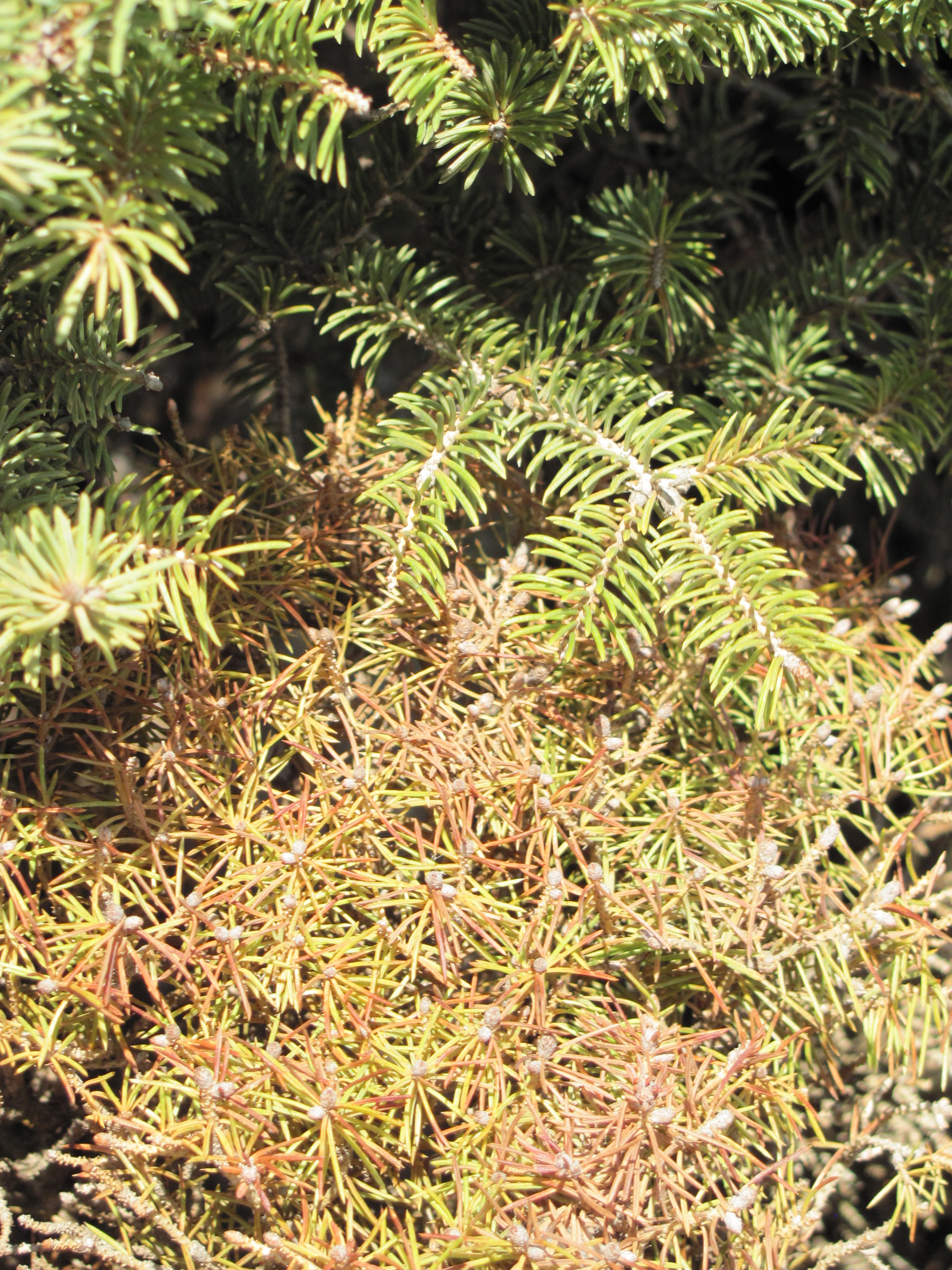
Good-bye to 2014 and hello 2015. It’s been an exciting year. Above average moisture this spring and summer had most of our trees full with leaves and fruit and our gardens bursting with produce. With this year coming to an end, do you know what it takes to make sure your evergreen trees and shrubs stay in good spirits into the New Year? Continue reading


Leave a comment

Don’t Eat That!! Holiday Plant Edition

The holiday season is upon us. The cookies are baked, the decorations are up, and the holiday plants are blooming with all of their glory. Some of our favorite holiday plants have a potentially dangerous side and can do more than just add color to our homes.

mistletoe

Mistletoe photo courtesy santarosa.ifas.ufl.edu

According to the Nebraska Regional Poison Center, plants were one of the top ten non-drug substances for human exposure in 2013. Do you think you know which of your holiday plants are safe and which ones are dangerous?

Amaryllis is near the top of the list for forgotten poisonous holiday plants. These plants are one of the more poisonous plants that are brought in during the holiday season. Amaryllis are often sold during the holiday season as a large bulb. Once these bulbs are watered, they produce long strap like leaves and a flower stalk containing brightly-colored, trumpet shaped flowers. The toxic chemical that these plants contain is called Lycorine. The most toxic part of these plants is the bulb. The other parts of the plants can also be toxic if they are eaten in large quantities.

Kissing under the mistletoe sounds like an innocent- enough holiday ritual. Try researching the many meanings of this holiday tradition just for fun. Real mistletoe is a common holiday plants that is sold dried in small packages to be hung in homes. The plant has green leaves and white berries and is a parasite-like plant that feeds off of other trees. With some species, eating a few of the berries would produce mild gastroenteritis, acute diarrhea and vomiting. Want to rethink kissing under a poisonous, parasitic plant?

Poinsettia

Poinsettia

Another holiday plant gets a bad reputation for being extremely poisonous, the poinsettia. According to research, they are not considered poisonous. According to the POISINDEX, the primary resource used by most poison control centers, a 50 pound child would have to eat more than 1.25 pounds of colored poinsettia bracts, about 500 to 600, to exceed the experimental dose. That is not to say that there wouldn’t be some stomach upset or vomiting if some were eaten.

Looking for some completely safe holiday plants? The Christmas cactus and kalanchoe are two plants that are deemed non-poisonous by the Nebraska Regional Poison Center. The Christmas cactus has flat, fleshy stems that resemble leaf-like pads which are joined to one another in a chain-like pattern. The flowers are usually held at the tips of the stems or in the ‘leaf’ axils and are usually pink to red. The kalanchoe has semi-fleshy leaves and flowers that are held in umbels above the leaves. The flowers come in a wide range of colors including yellow, orange, red, and pink to name a few.

Regardless of the plant, resist the urge to eat them and just admire the perfect holiday plant this season.

Upcoming Programs:

Extension Master Gardener- Two training sessions will be held at the Nebraska Extension in Hall County meeting rooms in Grand Island. Session 1: Tuesday evenings, February 3 through March 10, 6:00 to 9:00 PM. Session 2: March 16, 18, 20, 23, 25, and 27 from 9:00 a.m. to 4:00 p.m. Please contact Elizabeth Killinger, 308-385-5088, prior to January 9 with which Extension Master Gardener training session you are interested in attended. More information, updated schedules, and a brochure can be found at http://hall.unl.edu

For more information contact Elizabeth Killinger at ekillinger2@unl.edu, 308-385-5088, on Facebook, Twitter, her blog at http://killingerscollection.wordpress.com/, or visit the University of Nebraska-Lincoln Extension website: hall.unl.edu.


Leave a comment

Farm Bill Education

Brandy VanDeWalle's avatarViews from VanDeWalle

Crop producers are faced with a complex Farm Bill and important decisions to make. My colleague in Hamilton County, Todd Whitney wrote a good article on this so I’ve decided to share it in this week’s column. Landowners and producers should verify that their FSA Farm Numbers are correct for 2014 base acres and 2014 CC (counter-cyclical) program yields. Then, one-time farm program option decisions will need to be determined which will last for the next five years; following sign-ups.FarmBillPic

As a result, Farm Bill informational & meetings will be conducted in every county across Nebraska with each educational session running about 2½ hours. Check with your local Farm Services Agency (FSA) or Nebraska Extension Service (UNL) office for more details. These sessions are not required but may be helpful regarding long-term decisions.

Close training dates are as follows: Nov. 21 – Saline county (Saline Center) – 9 am, Nov…

View original post 514 more words